I used to be a
big Quentin Tarantino fan. A lot of my friends still are, and I will
readily admit that he is a man of great talent. He writes interesting
characters, unique nonlinear story lines, and chucks his movies full of
delightful foreign and classic film homage. I never really thought about all
the violence in his films, as they were so over the top that I failed to relate
to it. I got a bit upset when some of the characters I liked died in Jackie
Brown, but for the most part I could watch Uma Thurman scalp people with
her samurai sword without issue. We, the viewers, aren’t supposed to empathise
with any of his characters except the main protagonists. My thoughts on
violence have since evolved, and now I cannot watch the infamous "Bear Jew" scene
without actually sympathising with the poor Nazi on that one. And I hate Nazis.
 It was
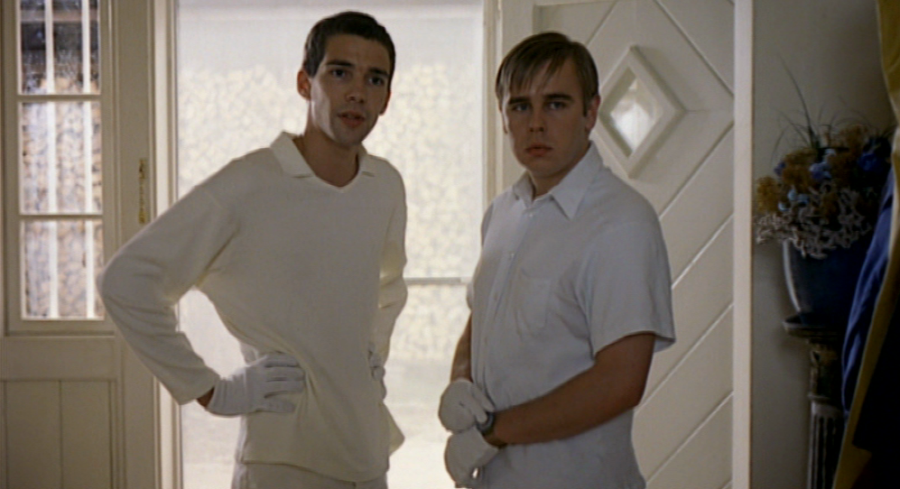
the Michael Haneke film Funny Games that
forced me to rethink the way we passively accept violence in film, and what it
says about us. Funny Games is an interesting exercise in
filmmaking, a film that is more about the viewer than what is happening on
screen. An affluent family of three goes to holiday in a lake house, and over
the course of their first night they are all brutally murdered by two young
boys. The boys speak to the camera several times in the film, acknowledging
that they will kill the family, yet still people watch. Haneke had hoped with
this film that people would walk out of cinemas in disgust, and that they would
realize how we callously accept violence without a second thought in film. Funny
Games is brilliant,
but it seems to have failed to change our culture.
It was
the Michael Haneke film Funny Games that
forced me to rethink the way we passively accept violence in film, and what it
says about us. Funny Games is an interesting exercise in
filmmaking, a film that is more about the viewer than what is happening on
screen. An affluent family of three goes to holiday in a lake house, and over
the course of their first night they are all brutally murdered by two young
boys. The boys speak to the camera several times in the film, acknowledging
that they will kill the family, yet still people watch. Haneke had hoped with
this film that people would walk out of cinemas in disgust, and that they would
realize how we callously accept violence without a second thought in film. Funny
Games is brilliant,
but it seems to have failed to change our culture.
Ever since seeing this I have tried to reconcile my thoughts on violence with
the films I watch. I stopped being able to watch shows like Breaking Bad and The Walking Dead which, in my opinion, used violence to drive the
plots forward, and had very little else to stand on. I got a bit zealous about
this for a while, but now I have moderated my viewpoint and developed
criteria for when violence is acceptable in entertainment. It is as follows:
Mega-producer Harvey Weinstein, who has produced all of Tarantino’s films, announced last year that he was going to stop making films that glorified gun violence, and instead only use violence in more accurate forms, citing his film Lone Survivor. It seems unlikely now that he will stand behind his statements, but at the time it opened a discussion in the entertainment world about violence in films. This is a discussion that needs to remain open, especially as America seems to continually manufacture angry young white men with a propensity to violence. Instead of filmmakers like Tarantino desensitising their audiences to violence, what we need is more Mike Leighs and Michael Hanekes teaching us empathy.
I) When it is absolutely necessary to the plot, and it is shown in a way that is meant to be upsetting. Violence should never be employed artistically. Example: Do the Right Thing, In Bruges, Hamlet
II) When the film is set in war, or based on historical events. War is hell, historically people have been brutal, and they should be so accurately depicted. Example: The Deer Hunter, Full Metal Jacket, HBO’s Rome
III) When the filmmakers are taking a moral sabbatical, and exploring a story through the admitted “bad guys” perspective, violence is often integral and permissible. Example: The Godfather, Richard III
IV) As a thought exercise. Sometimes over the top violence can be used to get people thinking. Example: Funny Games, Titus Andronicus, I’ll even accept Pulp Fiction with this argument.
I don’t really mind it too much
when it’s cartoonish violence, either, like when people die in the background
of James Bond films or Die Hard. I
think that’s a pretty lax list actually, as I don’t want to come off as a
fanatic pacifist, but I do think that this is worth talking about. This is not
a moral crusade or a call for censorship I am on, I just want to ask some
legitimate questions about what we as a society are hoping to get out of
violent films.
Are we hoping for some delayed
sense of justice by watching slaves and Jews seek violent revenge on slave
masters and Nazis? For what purpose? Are we using this violence as a means of
escape, to transplant ourselves from this reality? At what cost? Why do we
passively accept movie violence when we all agree that real world violence is
evil?
Mega-producer Harvey Weinstein, who has produced all of Tarantino’s films, announced last year that he was going to stop making films that glorified gun violence, and instead only use violence in more accurate forms, citing his film Lone Survivor. It seems unlikely now that he will stand behind his statements, but at the time it opened a discussion in the entertainment world about violence in films. This is a discussion that needs to remain open, especially as America seems to continually manufacture angry young white men with a propensity to violence. Instead of filmmakers like Tarantino desensitising their audiences to violence, what we need is more Mike Leighs and Michael Hanekes teaching us empathy.
Comments
Post a Comment